Skip to content
Start a request
Menu

RFQ · CLARIFICATION · DRAWINGS · FAT · LOADING

How an order runs, and the questions engineers actually ask.

18 answers. Each one carries a document, a number or a limit — no adjectives.

The delivery rail begins here: a short accent segment running into four step nodes
  1. 01Technical & customisation
  2. 02Quality, testing & documents
  3. 03Shipping, MOQ & lead time
  4. 04After delivery

Seven steps, and the limit on each one

Delivery rail: one line through seven steps, from request for quotation to after-delivery support
  1. 01

    RFQ

    Send what you have: quantity, U height, width × depth, load, destination.

    No drawing required to open a file.

  2. 02

    Technical clarification

    We come back with what your scope did not answer — rail pattern, door type, cable entry, door swing — in one message, not five.

    One round, written, in English.

  3. 03

    Drawing approval

    You get a dimensioned drawing and a labelled packing plan.

    Production starts only after you approve it in writing.

  4. 04

    Production

    Standard racks 15–30 days from approval; custom racks and containment 4–6 weeks.

    Appearance checked on 100% of units, key dimensions sampled, ground continuity tested on every unit.

  5. 05

    Pre-shipment inspection

    Your inspector's or your third party's, before the unit is crated. In-process photos on request.

    Nominate the agency at RFQ.

  6. 06

    Loading & documents

    Containment panels ship vertically in A-frame crates. Invoice with HS code, packing list with serial numbers, bill of lading, one product certificate per unit.

    Loading photos go out before the container is sealed.

  7. 07

    After delivery

    Main structure warranted for not less than 5 years. Technical support for delivered systems runs 24/7, first response within 2 hours.

    Answered by the same team that approved your drawing.

01 Technical & customisation

A01

What do you build as standard, and what is custom?

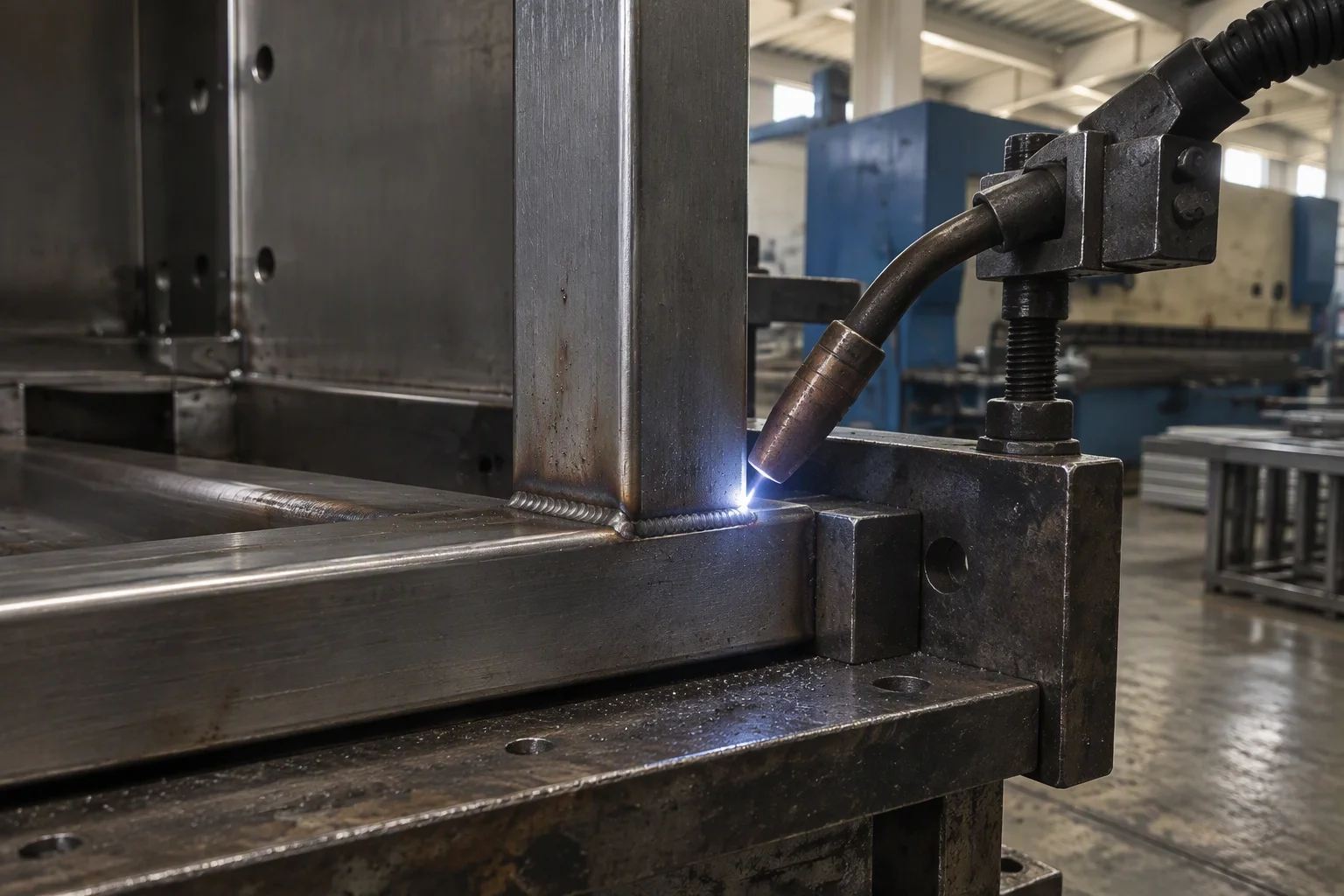
42U (2000 mm) and 47U (2200 mm) are the standard builds; taller or shorter heights are made to order. Widths 600 mm and 800 mm; depths 1000, 1100 and 1200 mm, up to 800 × 1200 mm. The frame does not change with the order: 2.0 mm uprights, 1.2 mm doors, SPCC cold-rolled steel from Baosteel or Ansteel.

A02

We run racks of three different depths in one row. Can one containment kit close it?

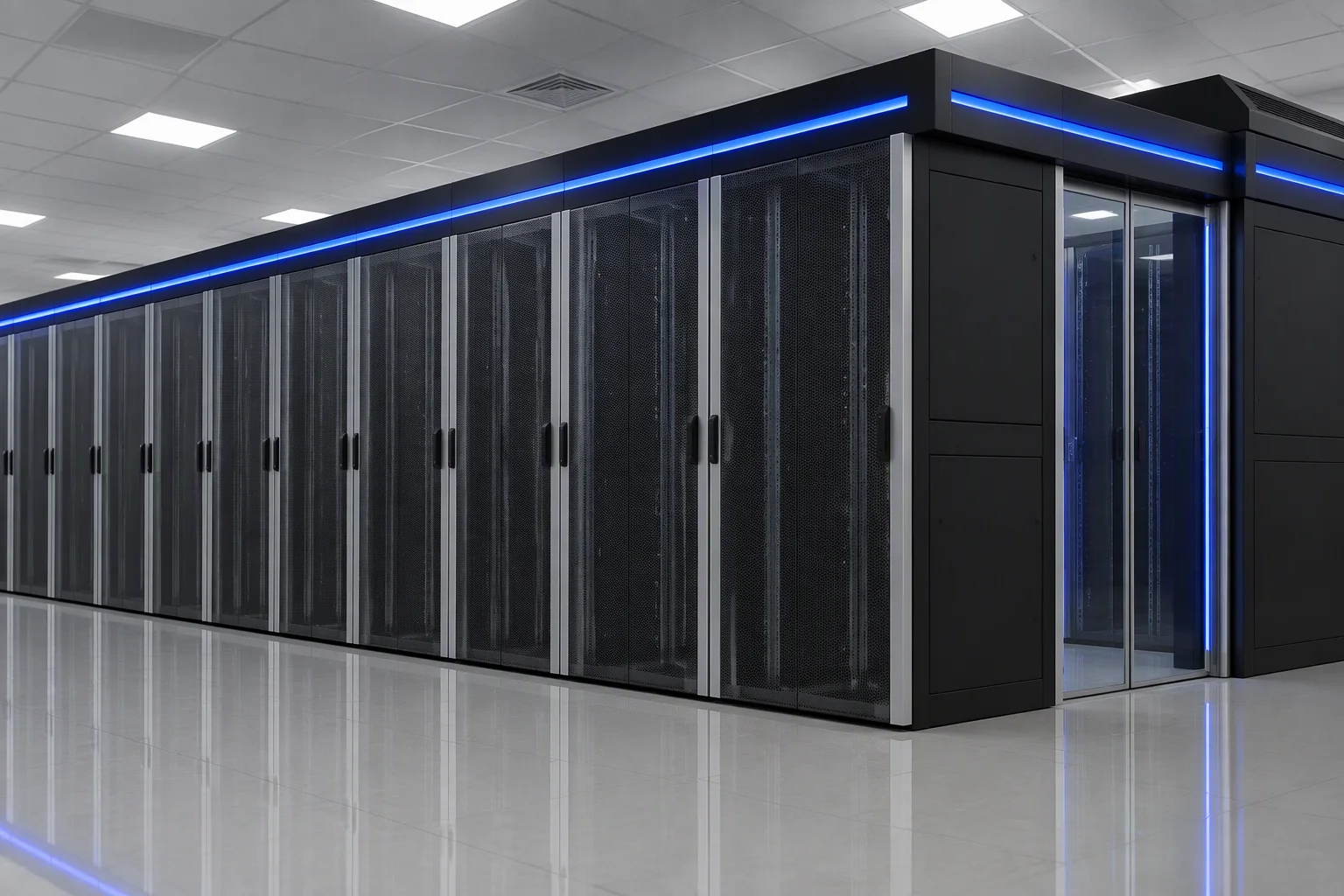
Yes — but it is built to your row, not to a catalogue. Send the depth of every rack in the row and the swing or slide direction of the end doors. Where depths differ, the transition detail is shown on the approval drawing before production. Aisle runs are built in 3–8 cabinet modules and can be extended later.

A03

What can we mount inside — our own PDU and busway?

Every rack leaves with mounting positions reserved for intelligent busway and PDU, front and rear. The distribution equipment itself is your scope, or ours as a separate line item; we do not fit it at the works.

A04

What is the static load rating, and what backs the figure?

1000 kg static load on the standard frame; 1500 kg on reinforced-frame models. The 1000 kg is our published standard rating. The third-party load test report we hold — 3 pages, Guohua Testing & Certification — records the enclosure loaded to 1500 kg on reinforced-frame models. Read the report page by page; we send the PDF before you ask for it.

A05

What door mesh area do you supply? Our CRAC sizing assumes it.

Front door ≥75% open area, rear door ≥60%. Both doors are mesh as standard; door type is a line item, so tell us what your airflow design assumes. Ground continuity is measured on every unit before packing — ≤10 mΩ between front door, rear door, side panels, mounting rails and the frame.

Ask a technical question we did not answer

02 Quality, testing & documents

Which test reports can you send before we place an order?

Three, all from third-party laboratories: the CAICT seismic test report for cabinets (18 pages), a load test report (3 pages) and a cold aisle containment test report (4 pages). PDF copies on request; add the printed set to the shipping documents if your import file needs it.

Which management-system certificates do you hold?

ISO 9001:2015, ISO 14001:2015 and ISO 45001:2018, issued through a Beijing certification body; national high-tech enterprise registration; a registered trademark; 3 granted utility model patents and 1 software copyright (Cold/Hot Aisle Management System V1.0).

Can our own inspector come before the container is sealed?

Yes. Nominate the agency at RFQ so the unit is still uncrated when they arrive. In-process photos are available on request.

What does the certificate of conformity actually cover — and what does it not?

It states the standard the unit was built and tested to, and it is issued per unit. We do not issue a market-access certificate we do not hold. If your import file needs a scheme we do not have, you will read that in the RFQ reply, in writing — we would rather lose the order than send you a document we cannot back.

This answer carries no document, and that is the point of it.

Ask for the documents

03 Shipping, MOQ & lead time

  • 18units / 20GP loose
  • 38units / 40HQ loose
  • 15–30 daysstandard racks
  • 4–6 weekscustom & containment
  1. L01

    How many racks fit in a container?

    For a 42U, 600 × 1200 mm rack: about 18 units loose-loaded in a 20GP and about 38 in a 40HQ. Palletised, about 20 per 40HQ. These loads are limited by carton height — 2200 mm against a 2280 mm door — not by weight; a full 40HQ is still under a fifth of the container's payload.

  2. L02

    What is your minimum order?

    One unit for a standard rack. A colour, logo or packaging change starts in single digits; a new frame or new door tooling is quoted per project. Containment and micro-modular systems are quoted per project and have no unit minimum. In practice the container is the commercial unit — 38 racks loose-loaded.

  3. L03

    What is the lead time?

    Standard racks: 15–30 days from drawing approval. Custom racks and containment: 4–6 weeks. A containment package for a whole hall is scheduled per project; on a large batch allow 12 weeks to first delivery. Production does not start before you approve the drawing.

  4. L04

    Which port, and which Incoterms?

    FOB, Chinese seaport. CIF to your discharge port on request; sea freight is repriced monthly, so a CIF quotation carries a validity date. Other terms are quoted case by case.

  5. L05

    How do we pay?

    T/T 30/70 — 30% with the order, 70% against the bill of lading copy after your pre-shipment inspection. L/C at sight for larger orders. One rule we do not bend: the account name on any invoice is the company name on the contract, never a personal account.

  6. L06

    How are the containment panels packed, and what travels with the container?

    Panels ship vertically in reinforced A-frame crates with a separator between every panel — never flat-stacked, because a flat-stacked panel fails in transit. A-frames are fixed to the container floor on vibration pads. Documents: commercial invoice with HS code, packing list with serial numbers, bill of lading, and one product certificate per unit. Crating is plywood where possible; solid-wood components are heat-treated and stamped.

Ask about a specific shipment

04 After delivery

What is the warranty, and how do we get spare parts?

The main structure carries a warranty of not less than 5 years. Technical support for delivered systems runs 24/7, with a first response within 2 hours, in English, from the same engineering team that approved your drawing. Spare rails, locks and castors are quoted as line items — put them on the same order and they ship in the same container.

Who installs it?

Installation is done by your contractor. What we ship is the part that decides how long it takes: the approved layout drawing, a labelled packing plan so the aisle goes together in the order it was designed, and an assembly sequence. A single-row intelligent cabinet is installed in about 3 hours; a dual-row aisle module is typically deployed in 2–3 weeks including commissioning.

What monitoring comes with the micro-modular and single-row systems?

Both support remote access over the network and SMS alerting; the single-row cabinet has smoke-sensor interlock and emergency ventilation. Tell us the protocol your BMS or DCIM expects at RFQ and we will confirm what the controller exposes, in writing. We show functions as text and parameters, not as screens.

What we ship for installation

  1. 01Approved layout drawing
  2. 02Labelled packing plan
  3. 03Assembly sequence
  4. 04Commissioning checklist

Ask about after-delivery support

Ask the one we did not answer.

Send the question and the project it belongs to. Requests are either accepted or explicitly refused — never silently dropped. You can also mail sales@ems-rack.pages.dev.

Ask the one we did not answer