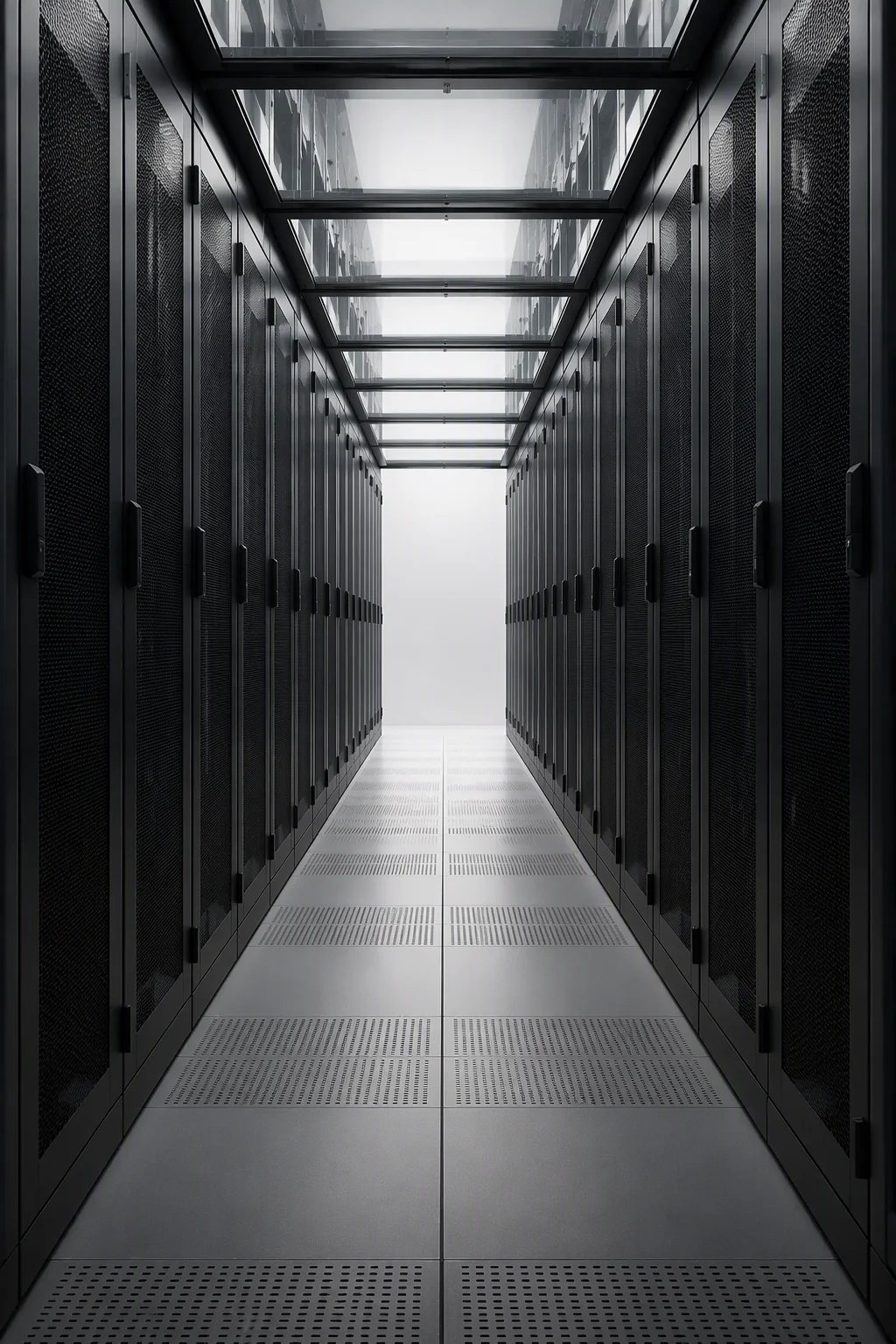
The sheet metal line behind the AI rack
RackForge is a factory brand, not an assembly of subcontractors. Every cabinet we quote is cut, formed, welded, coated and inspected on one six-process sheet metal line — laser, punch, bend, weld, coat, assemble — and the same floor now builds the cold aisle containment and busway/liquid-cooling structures that surround those cabinets. The numbers we sell are the numbers the line can hold: ±0.1 mm forming tolerance, 1,600 kg static load proven at a 4× safety factor, 80–100 µm C4-class powder coat, and a 30-day standard FOB lead time.
Request a Quotation How the Line Grew
6 processes in-house · ±0.1 mm · 4× load-tested · MOQ 5, samples in 15 days
One line, four chapters
The line added capabilities in the order a data hall actually consumes them: steel first, then cabinets, then the aisle around them, then the AI-grade loads inside. Each chapter kept the previous one — the bending department that started on enclosure panels still sets the five-bend profile on today's 2.0 mm uprights.
The sheet metal workshop
The line started as a sheet metal workshop cutting, bending and welding steel for industrial enclosures. The working rules set in these years still govern the shop: one setup per part where the drawing allows it, burrs broken before forming, and first articles proved on a CMM against a ballooned drawing.
Enclosure work paid for the first laser-nesting and bending capability — and taught the floor that tolerance is a process property, not a final inspection result.
Data center cabinet production
The line committed to 19-inch data center cabinets: 42U–52U frames in 600 and 800 mm widths, five-bend 2.0 mm SPCC uprights formed in a single setup, and static load ratings proven with weighted-plate tests rather than catalog copies. EIA-310-E hole patterns and IEC 60297 metric dimensions became the default, not an option.
This is the chapter where the 1,500 kg standard-frame rating and the 72-hour creep recheck discipline were written into the outgoing test.
Cold aisle containment systems
Customers kept asking who would close the aisle around the racks, so the line tooled its own answer: 12 mm tempered glass containment doors, fixed and drop-away roof panels on a 600 mm module, and brush-sealed blanking panels. Containment turned the cabinet maker into an aisle supplier, with retrofit halls closing 12 aisles at a time without stopping the floor.
Fire-linkage release under 3 seconds and tool-free panel installation date from this chapter.
The RackForge AI rack brand
The line consolidated its AI-grade work under the RackForge name: 1,600 kg GPU frames rated for 40–132 kW per cabinet, busbar-slot columns to a 400 kW per rack-position design ceiling, and liquid-cooling ready builds with manifolds pressure-held at 1.5× working pressure for 24 hours. NVL72-class footprints and OCP ORv3 alignment are handled at the punching stage.
Racks now ship to data halls across 12 export countries, with the serial-matched test log travelling inside every crate.
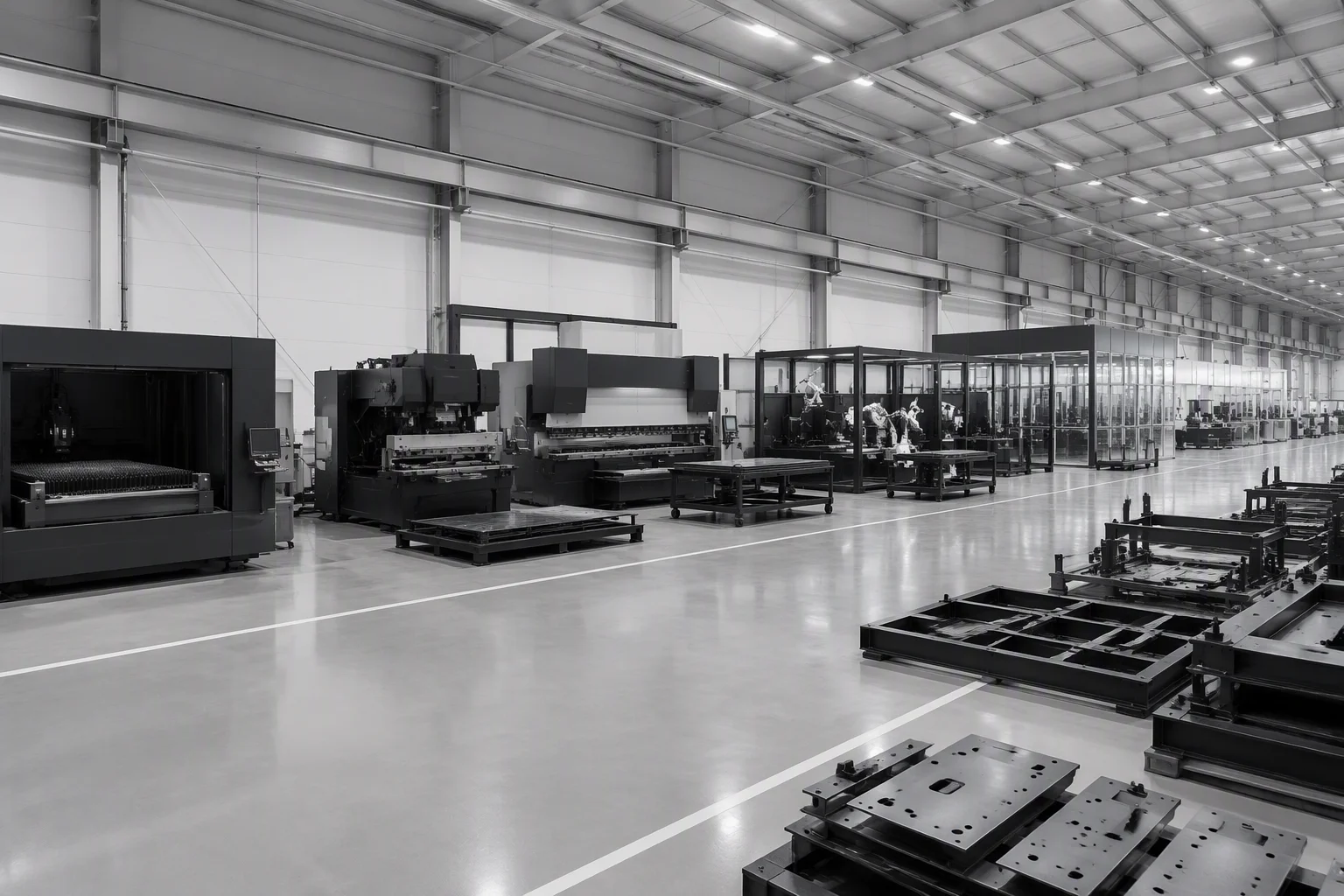
From sheet steel to the system boundary
Most rack vendors stop at the cabinet and leave the aisle to someone else. We kept going outward, because the boundary is where performance is won or lost: an uncontained aisle bypasses 25–50% of cooling air, while a sealed cold aisle brings leakage down to a 3–10% band and turns a retrofit into measurable PUE movement.
- Frames: five-bend 2.0 mm SPCC uprights at ±0.1 mm, rated 1,500 kg standard and 1,600 kg for high-density GPU builds.
- Coating: four-stage pretreatment with electrostatic powder at 80–100 µm, C4 class, batch-validated to 480 h neutral salt spray.
- Boundary: 12 mm glass doors, roof panels and brush sealing that close the cold aisle our racks open.
- Integration: busbar slots and coolant manifolds factory-fitted, so the aisle arrives powered and piped — not as three follow-on site packages.
Certifications we hold, standards we build to
The management system is ISO 9001, and the CE package covers the LVD, EMC and RoHS directives with safety testing to EN IEC 62368-1 on any configuration that carries electrical accessories. The dimensional and seismic entries below are build standards: every frame ships EIA-310-E and IEC 60297 compliant, and Zone 4 seismic kits are an orderable option rather than a blanket rating.
certificate copies travel in the shipment dossier · claims without a test record stay off this site
Where a rack earns its shipping crate
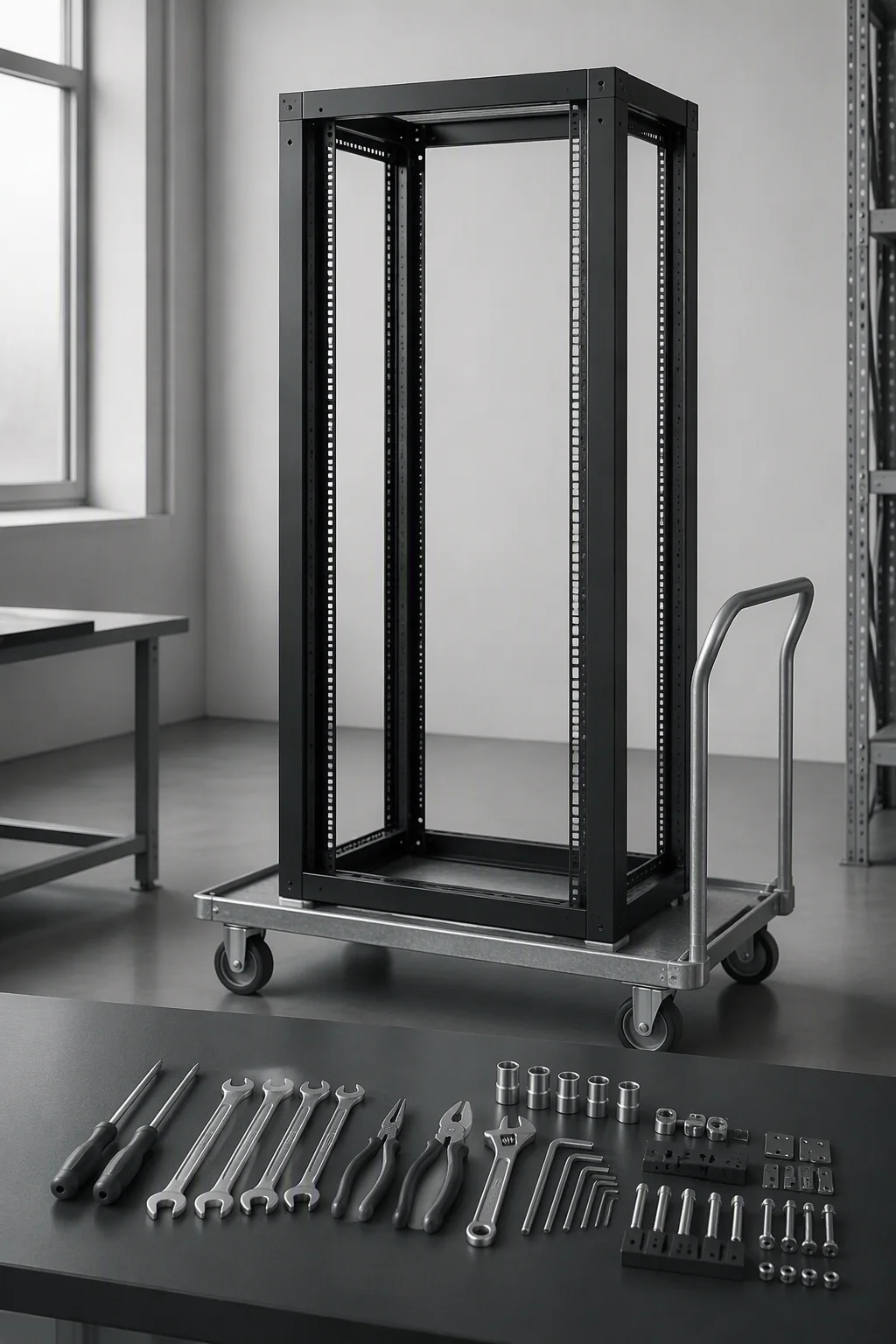
Assembly is the last place errors can hide, so it is run like an inspection station that happens to hold screwdrivers. Fasteners go in with calibrated tooling at logged torque, grounding busses are bonded frame-to-frame and measured at ≤0.1 Ω, doors are cycle-checked on their hinges, and the serial number on the frame is printed onto the test log that folds into the crate.
Nothing waits for the crate to be found. A high-density frame leaves only after its 4× static hold and creep recheck are on file — typically 0.8 mm deflection against a 1.0 mm limit — and a liquid-ready build adds a 24-hour manifold pressure hold with the curve stapled to the order. If a number is missing, the rack stays; the 3-year warranty is underwritten by that rule, not by hope.
ground continuity ≤0.1 Ω · torque logged · serial-matched test log in every crate
Work with the floor that bends the steel, not a catalog that resells it
6 processes in-house · 4× load-tested frames · 30-day FOB lead, MOQ 5