The question is no longer which standard wins. Hyperscale operators buy ORv3 for its power architecture; colocation and enterprise floors buy 19-inch because the installed base of equipment is 19-inch. The practical question is what a rack supplier must punch, drill and document so that a buyer can deploy one, the other, or both on the same floor without discovering the incompatibility during commissioning.
The dimensional baseline of each standard
Start with the geometry, because everything else follows from it:
| Parameter | EIA-310-E (19 in) | OCP Open Rack v3 |
|---|---|---|
| Equipment width | 19 in panel — 465 mm mounting-hole centres, 450 mm hole spacing | 21 in equipment opening; external width options around 600 mm and 706 mm depending on the implementation |
| Vertical unit | 1U = 44.45 mm (1.75 in); three-hole repeating pattern | 1 OU = 48 mm; rack heights quoted in OU |
| Typical height | 42U–52U frames, 1991 mm to 2461 mm overall on this line | 44 OU / 47 OU class racks, roughly 2,286 mm overall |
| Typical depth | 1,000–1,200 mm, with rail adjustment of ±65 mm for depth travel | Varies by implementation — deeper cabinets for rear cable and liquid routing are common |
| Load class | 1,500 kg static standard, 1,600 kg on high-density builds, verified at 4× | Published base and heavy-duty classes in the 1,400–1,600 kg range |
| Vertical power | Rack PDUs and busbar-slot columns, 250–800 A tap-off classes | 48 V DC busbar inside the rack with blind-mate shelf connection; ORv3 power shelves in the 15–18 kW class and above |
Three of those rows cause most of the trouble in practice: the 465 mm hole centres, the 44.45 mm versus 48 mm vertical pitch, and the fact that 21-inch equipment will not bolt into a 19-inch opening without an adapter.
Hole patterns: square, round and universal
EIA-310-E defines three mounting-hole patterns, and only one of them is what modern equipment expects. The universal pattern alternates a wide-spaced hole with a close-spaced pair on the U boundary; the wide pattern spaces holes evenly at the larger pitch; the round-hole pattern is the legacy telecom arrangement. Practically, the industry standardised on square holes on the EIA pitch because square holes take cage nuts without a tool and hold them against rotation while a screw is driven.
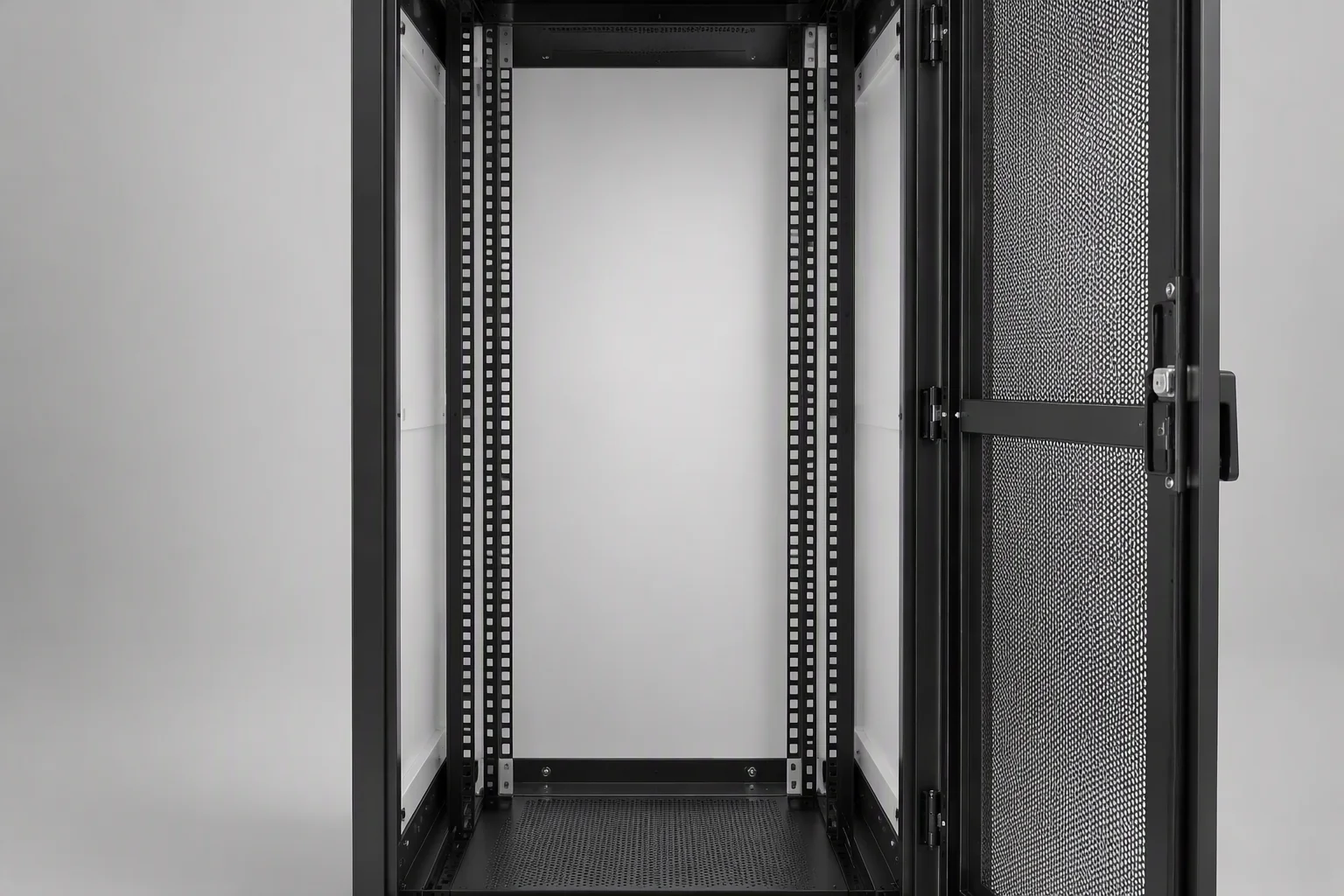
RackForge rails are punched at true EIA-310-E spacing, marked U-by-U so a rail position can be read over the phone during a retrofit, and adjustable ±65 mm in depth. Square holes also accept the leaf-spring clips that hold 1U–4U blanking panels without tools — which is why the sealing components and the rails belong on the same drawing.
ORv3 mounting differs in kind, not only in dimension. Equipment is generally designed to slide on rails and latch, with tool-less attachment and blind-mate connections for both power and coolant. Hole positions exist to fix rails and posts rather than to accept cage nuts per U, so the mounting detail that works on an EIA rail is not automatically the detail that works on an ORv3 post.
U pitch versus OU pitch: the arithmetic that catches projects
U and OU are both vertical units, and they are not the same size. At 44.45 mm per U, a 48U opening measures about 2,134 mm of usable rail; at 48 mm per OU, a 44 OU opening measures about 2,112 mm. The totals look similar, which is precisely the trap: plan a rail and shelf layout in U, order it in OU, and the error accumulates down the rack. The consequences worth planning for:
- Every U count must be re-derived, not converted. A 42U air-cooled plan does not map to a 42 OU ORv3 plan.
- Power shelf positions move. ORv3 places power shelves in OU slots rather than in a fixed zone, so shelf height is a layout decision. On the RackForge GPU frames, power-shelf rails can be pre-punched to the GB200/GB300 recommended positions before the frame is welded and coated.
- Blanking and sealing have to match the pitch. A 1U blank panel is 44.45 mm tall; in an ORv3 frame the same gap is a different height and needs its own part.
- Containment adds a second grid. Doors and roof panels land on a 600 mm module tied to the rack row, so OU height changes do not move the roof but do change where blanking stops.
Rail mounting and the depth question
On a 19-inch frame, rails carry the load and set the depth. On this family, rails are EIA-310-E square-hole, U-marked and adjustable ±65 mm in depth, and the same uprights are five-bend formed on 2.0 mm SPCC to ±0.1 mm so a rail position is repeatable down a row. Deep GPU builds move to 800 × 1200 mm frames, where the extra depth exists for vertical cabling and, on liquid builds, for the manifold path over the door lines.
On an ORv3 rack, rails are part of a latch system and the power interface sits behind them. That difference drives three specification questions for a buyer comparing the two:
- How is the IT load carried — rails to posts, or rails to a latch rail? A rack quoted with pre-punched power-shelf positions has to be punched for the shelf system being installed.
- Where does the busbar run? ORv3 uses a busbar inside the rack, typically a 48 V DC spine with blind-mate shelf connection. A 19-inch AI rack usually feeds a rack PDU or a tap-off box from a column slot. Both are vertical, and both compete for the same rear-corner space.
- Is the coolant interface shared? Liquid manifolds and UQD pairs appear on both sides of this comparison. On a RackForge liquid-ready frame they run above the front and rear door lines at fixed coordinates, pressure-held at 1.5× working pressure for 24 hours.
Where the two diverge most: power and cable routing
The mechanical difference is visible with the doors off. ORv3 architecture centralises power: a single power zone, a 48 V DC busbar, and power shelves that can sit in any OU slot, with cable routing at the front across the full height and entries prepared in the roof and base. A 19-inch AI rack distributes differently: a rack PDU on a 0U vertical rail, or a tap-off box landing on a busbar-slotted column at up to 320 A per position, with lacing bars on a 4U pitch and overhead trough brackets carrying 100 × 100 mm or 200 × 100 mm sections.
The underlying engineering converges, which is what makes a mixed row practical:
- Both are planning around the same power ceiling. The 400 kW per rack-position class is now the design reference on the 19-inch side too, carried by twin 320 A tap positions in an 800 A class.
- Both are liquid-capable. ORv3 v3 added spec-compliant manifold support; RackForge liquid-ready frames ship with manifolds, UQD pairs and a pressure record.
- Both carry the same grounding discipline. Frame-to-frame continuity at ≤0.1 Ω with factory-fitted jumpers is a requirement on either pattern.
- Both are usually ordered with the same finish. C4-class powder at 80–100 µm, batch-validated to 480 hours of neutral salt spray, because the building does not care which standard is inside it.
Mixing the two in one row
Most floors will run both for years. 19-inch equipment is the installed base and remains the cheaper option for storage, networking and general compute; ORv3 gear arrives with AI clusters. Three rules keep them compatible:
- Keep the row module common. Racks at 600 mm and 800 mm widths on a 600 mm containment grid let both patterns sit under the same roof panels and behind the same 12 mm glass doors.
- Use adapters deliberately. 19-inch equipment mounted into a 21-inch opening needs adapter brackets — a half-height, 1U or 2U part depending on the unit. They work, but they consume the width advantage and should be a planned phase, not a permanent improvisation.
- Standardise the interfaces you can. Grounding at ≤0.1 Ω, C4 coating, 1,600 kg static at a 4× safety factor and 30-day FOB lead time hold on either build, so a mixed row has one quality baseline even with two mounting standards.
- Do not print the wrong compliance line. A 19-inch frame is not an ORv3 rack. RackForge ships EIA-310-E and IEC 60297 compliance as standard and quotes ORv3-compatible builds on request, aligned at the punching stage rather than claimed on the datasheet.
The family this note describes — 42U–52U, 600 and 800 mm widths, 1,500 kg standard and 1,600 kg high-density load classes — is specified on the standard server rack page, with NVL72 footprint alignment and ORv3-compatible quoting on the GPU high-density page. If the decision behind the standard question is really a power-density decision, start from From 8 kW to 132 kW — Sizing Racks for AI.