HPC & Research — Warm-Water Liquid Cooling

HPC budgets are won and lost on the energy bill, and the peer-reviewed verdict is in: direct-to-chip liquid cooling cuts total facility power by up to 14.4% depending on inlet temperature. Adoption is still early — Omdia counted only about 19% of data centres running liquid in 2024, with another 36% planning it — which is exactly why the window matters. Equipment demand jumped from roughly $1.3B in 2024 to $2.2B in 2025, up 68.2% in a year, and the machines setting the Green500 efficiency leaderboard — including 30 MW-class exascale builds — run warm-water direct-to-chip loops as standard. RackForge builds the rack half of that loop: manifolds above both door lines, UQD pairs at fixed coordinates, 25–80 L/min on PG25, pressure-proven at 1.5× for 24 hours before the crate closes.

Request a Quotation Air vs Warm Water, in Numbers

−14.4% facility power · 19% → 36% adoption · 25–80 L/min on PG25

Thermal strategy

Air-cooled HPC hall vs warm-water liquid-cooled row

Seven rows that decide how a research computing budget spends the next decade. The left column is the air tradition; the right column is where the efficiency rankings and the equipment orders have already moved.

Thermal strategy Air-cooled HPC hall Warm-water liquid-cooled row
Heat removal path Air CRAC volume flow plus rear-door exchangers at best Water Direct-to-chip warm water, manifolds factory-fitted above the doors
Facility energy Air The baseline every grant application now apologizes for Water Up to −14.4% total facility power, peer-reviewed, by inlet temperature
Density ceiling Air Saturates around the 40 kW-class rack Water 40–132 kW liquid envelope per cabinet on the RF-LC frame
Chiller dependence Air Mechanical chilling most hours of the year Water 45°C warm water benchmark — a chiller-free operating envelope
Adoption curve Air The 81% majority, aging toward retrofit Water 19% deployed in 2024, 36% more planning; AI-server attach 14% → 22% by 2026
Equipment demand Air Flat, replacement-rate spending Water $1.3B (2024) → $2.2B (2025), up 68.2% year on year
Where the flagships are Air Outside the top efficiency rankings Water Green500 leaders and 30 MW-class exascale machines run warm-water loops
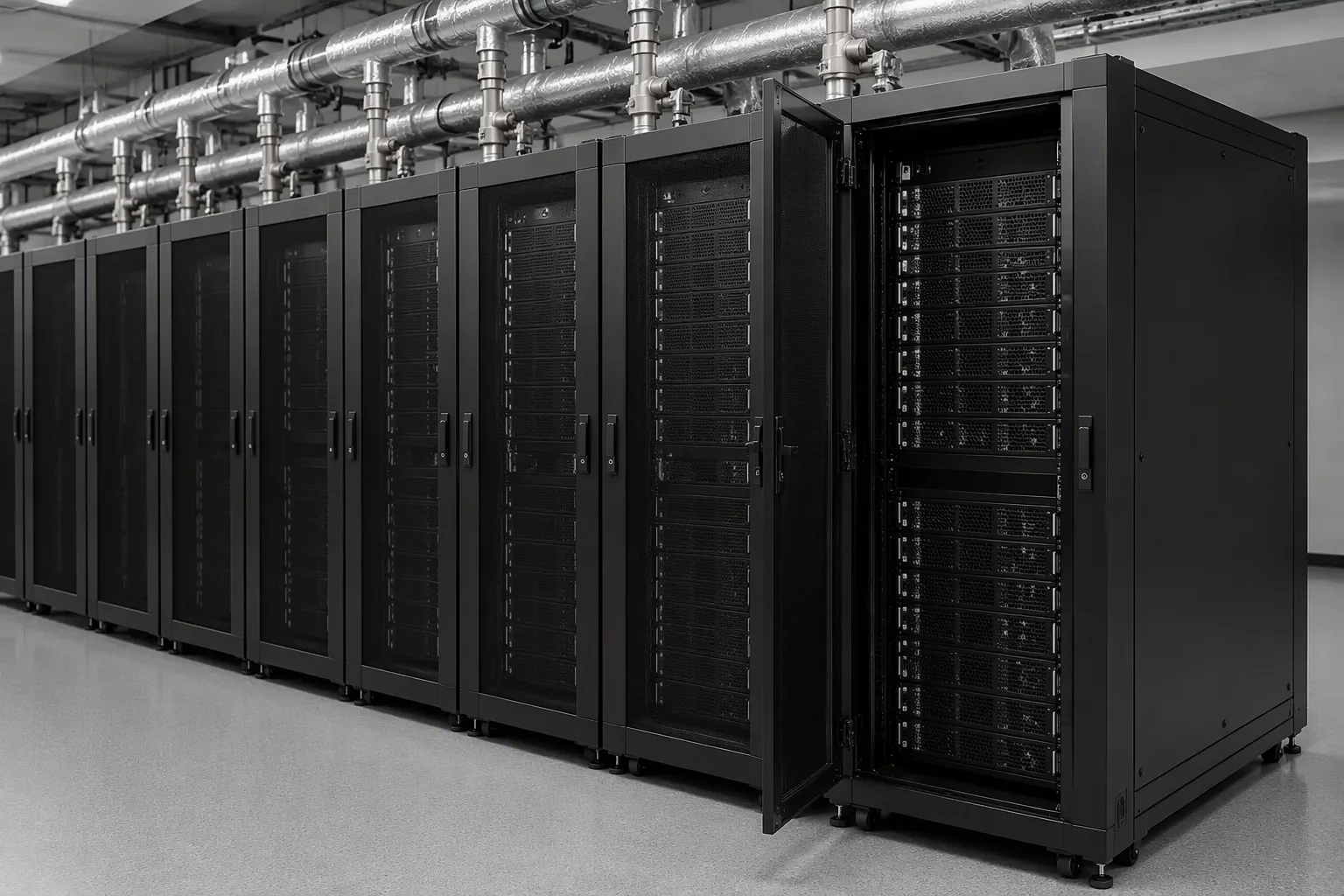
HPC row of liquid-cooled cabinets with manifold piping routed above the doors in a cool research hall
The loop on the rack

The last metre of the loop is factory work, not thesis work

A direct-to-chip deployment fails at its fittings far more often than at its science. RackForge builds the rack-side metre in the factory, to a drawing, under a pressure test — so the facility team connects headers to ready hardware instead of inventing an interface in the room.

  • Manifolds above the doors: supply and return headers on both door lines, drilled to the signed layout drawing, revision-matched to the crates on the dock.
  • UQD quick disconnects: drip-less pairs at fixed, repeatable coordinates for CDU-side hookup, capped and tagged at dispatch.
  • Proven before shipping: the loop holds 1.5× working pressure for 24 hours; the zero-drop record travels with the rack, serial-matched.
  • Warm-water alignment: flow of 25–80 L/min on PG25, benchmarked against the 45°C facility-water practice of chiller-free warm-water plants.
Specifications

Hydraulic and structural sheet for the HPC row

Example SKU RF-LC-48U on an 800 × 1200 mm frame; 52U builds (2461 mm / 96.9 in) quoted for maximum-density rows. CDU heat-capture classes below are design alignment benchmarks drawn from published direct-to-chip system data, not capacity claims.

ParameterRF-LC Specification · HPC build
Design flow25–80 L/min per rack, balanced per branch
Working fluidPG25 — 25% propylene glycol / water
Quick disconnectsUQD pairs, OCP-aligned interface, drip-less, capped and tagged
Manifold routingabove front and rear doors, drilled to approved drawing
Branch boreDN50 rack manifolds · DN100–DN150 row headers, design alignment
Warm-water benchmark45°C facility water — chiller-free operating envelope
Power envelope per cabinet40–132 kW, liquid builds
Static load1,600 kg · 4× safety factor · 72 h hold with creep recheck
Width × depth800 × 1200 mm · 52U height 2461 mm / 96.9 in optional
Pressure proof1.5× working pressure · 24 h hold · zero-drop record shipped
Leak detectiondrip pans standard · per-rack leak-sensing rope optional
Groundingmanifold-to-frame bonding ≤0.1 Ω
Doorsfront mesh ≥80% open area · glass front option for lab tours
StandardsEIA-310-E · IEC 60297 · CE (EN IEC 62368-1) · RoHS
Related products

Three line items behind the liquid row

The liquid frame, its high-density sibling and the cable hardware that keeps 132 kW cabinets serviceable.

Liquid-Cooling Ready Racks

The full hydraulic specification: manifolds, UQD pairs and drip pans pre-installed, 1.5×/24 h pressure proof, 25–80 L/min on PG25.

  • Zero-drop record ships in the crate
  • Above-door routing, both door lines
  • Leak-sensing rope option per rack
Liquid-cooling ready racks →

GPU High-Density Racks

For the air-cooled end of the machine room: 1,600 kg frames, busbar-slot columns and NVL72-class footprint alignment up to the 40 kW air limit.

  • 40–132 kW liquid envelope shared
  • NVLink braced frame option
  • OCP ORv3 compatible
GPU high-density racks →

Power & Cable Management Structures

Vertical PDU mounts, lacing bars, overhead trough brackets and grounding kits — the unglamorous hardware that keeps a liquid row maintainable between flushes.

  • PDU rails, depth-adjustable
  • Grounding ≤0.1 Ω continuity
  • Service-side cable paths preserved
Power & cable structures →
Brushed steel texture

Put the loop where the ranking is.

−14.4% facility power · 1.5×/24 h pressure proof · 25–80 L/min · MOQ 5