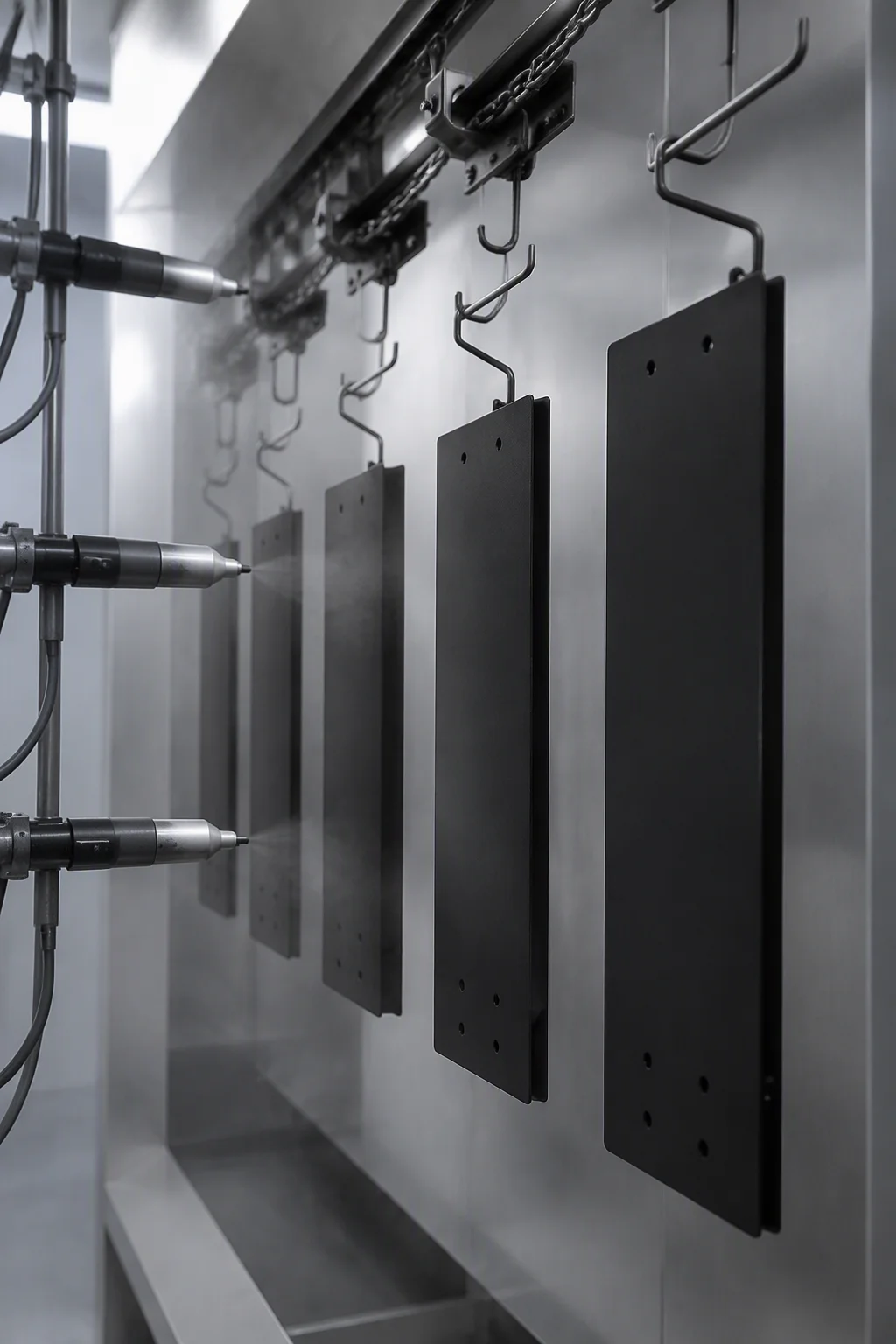
Coating failures in a data hall rarely look dramatic. They start as a chalky sheen on a top panel, a rust bloom at a cut edge behind a PDU rail, or a film that lifts when a rack is re-bayed. By the time any of it is visible, the mechanism behind it — too thin a film, a skip in pretreatment, an unmasked thread — is a year old. None of it can be inspected into a finished rack, which is why the specification has to be written as process parameters rather than as a colour.
C4 is an environment class, not a paint brand
Corrosivity categories under ISO 12944-2 describe what the atmosphere does to steel, and they set how much coating system a structure needs. Data hall steelwork usually sits in the C3/C4 range depending on the building — a sealed inland hall is far kinder than a coastal site or a hall drawing unfiltered make-up air from an industrial estate. RackForge coats to C4 as standard, which is the class chosen for coastal and industrial sites rather than the cheapest class that passes a dry indoor room.
| Class | Typical environment | Practical consequence for a rack |
|---|---|---|
| C3 | Urban and industrial inland, moderate humidity, low pollution | Adequate for sealed inland halls; leaves little margin for coastal freight or a humid site store |
| C4 — standard on this line | Coastal sites, industrial areas, halls with moderate pollution in the air stream | Pretreatment plus a 80–100 µm film, validated per batch to 480 h neutral salt spray |
| C5 | High salinity or aggressive chemical atmosphere | A project-specific system; quoted as an engineering case rather than a catalogue option |
The class matters most during the period nobody plans for: storage. Frames that sit in a humid warehouse, ride a ship in a container and then wait on a dock for a construction schedule are exposed for months before they ever see a data hall. A C4 system with 480 hours of salt-spray validation is chosen for that journey as much as for the room at the end of it.
Film build: 80–100 µm and how it is measured
Film thickness is the parameter that decides whether a coating is a barrier or a suggestion. Below roughly 60 µm, a powder film starts to lose hiding and barrier continuity at edges and bend radii; well above 120 µm it becomes brittle and chips instead of flexing. The RackForge window is 80–100 µm nominal, measured with a magnetic gauge at five points per panel, once per coating batch.
- Measure on the part, not on a coupon. A flat test plate coats differently from a five-bend column. The five points belong on real geometry, including at least one point near a bend where the film naturally thins.
- Record per batch, not per order. A 300-rack order runs through several coating batches. The thickness record should follow the batch, so a query about one frame in year three traces back to the batch that coated it.
- Threads and grounding points stay bare. Masking points are agreed at kickoff and marked on the drawing. A coated earth stud or a powder-filled cage-nut thread is a defect that a thickness gauge will never find.
- Cut edges and laser edges get attention. Every punched hole and laser-cut edge exposes untreated steel. Pretreatment before coating is what covers those edges; coating over mill scale or oil is what makes them rust first.
Adhesion: the test that finds the process fault
Salt spray tells you about the chemistry of the system. Adhesion tells you about the discipline of the line. A cross-cut test to ISO 2409 cuts a lattice through the film to the substrate, tape is applied and pulled, and the result is graded from 0 (no detachment) to 5. RackForge records class 0 — the best grade — on production parts, and the same reading appears in the outbound log of a high-density frame alongside load, thickness and ground continuity.
Class 0 is only achievable when all four pretreatment stages do their job: degrease, pickle, phosphate, rinse. Skip the pickling and the phosphate layer forms over oxide instead of over steel; rush the rinse and soluble salts stay under the film, pulling water in from the first humid week. Both faults pass a visual inspection and both fail a cross-cut. Adjacent checks worth naming in a specification are a pull-off adhesion test per ISO 4624 for a quantitative bond figure, and impact or bend tests to confirm the film flexes with the steel rather than cracking at a forming radius.
Salt spray: 480 hours as a batch-level claim
Neutral salt spray testing to ISO 9227 puts coated coupons in a continuous fog of salt solution and records how long the film survives before red rust or blistering appears. RackForge validates every coating batch to 480 hours with the acceptance criterion of no red rust and no blistering. Two things make that claim useful rather than decorative:
- It is a batch test, not a type test. A certificate earned once on a hand-prepared sample panel says nothing about the powder, the line settings or the pretreatment chemistry in week 30 of a production run.
- It is a coupon that travels. The batch coupon is retained so that a field question on serial number RF-48U-800x1200-GPU can be traced back to the coupon that represents its coating batch.
- It sets the warranty's foundation. A documented 480-hour record plus a 3-year finish warranty is a document trail; the same warranty without the records is a promise.
Salt spray is a comparative test, not a service-life prediction. Five hundred hours in a fog chamber is not five hundred hours in a data hall — the fog is far more aggressive. It is used to prove consistency between batches and to compare candidate systems, which is exactly how it should appear in a specification.
The process the film comes from
Coating is one of six processes on the RackForge line: laser, punch, bend, weld, coat, assemble. Keeping the coating in-house is what makes the parameters auditable — the steel that was punched is the steel that was pretreated and coated, under one batch record, rather than a job that left the building between operations.
- Substrate: SPCC 1.5–2.0 mm for frames and load-bearing members, 1.2–1.5 mm for doors and panels; SGCC and SUS304 quoted where the drawing calls for them.
- Pretreatment: four-stage degrease, pickle, phosphate, rinse — the stage that decides adhesion class.
- Application: electrostatic powder at 80–100 µm nominal, RoHS-compliant powder, cured per the powder maker's schedule.
- Masking: threads, grounding points and any mating surface kept bare by agreement at kickoff, then checked at assembly.
- Colour: RAL 9005 black standard, RAL 7035 light grey optional, with RAL 9004 also available on the standard rack line. Gloss level and masking points are customer inputs; the RAL code is confirmed at kickoff.
The coating clause to put in the purchase order
- System: C4 corrosivity class to ISO 12944-2, four-stage pretreatment, electrostatic powder.
- Film build: 80–100 µm nominal, magnetic gauge, five points per panel, recorded per coating batch.
- Adhesion: ISO 2409 cross-cut class 0 on production parts.
- Corrosion: ISO 9227 neutral salt spray 480 hours per batch, no red rust, no blistering.
- Masking: threads and grounding points bare, points listed on the drawing rather than left to the painter.
- Traceability: coating batch ID and retained coupon linked to the frame serial number.
Written that way, the finish becomes a measurable part of the product. The line, the batch records and the retained coupons are described on the factory page, and the inspection formats — thickness, salt spray and adhesion rows in the same table as the load and continuity checks — are set out on the quality page. Contract coating and contract sheet metal under drawing NDA run through the same sheet metal OEM line, with the same pretreatment stages and the same per-batch validation.