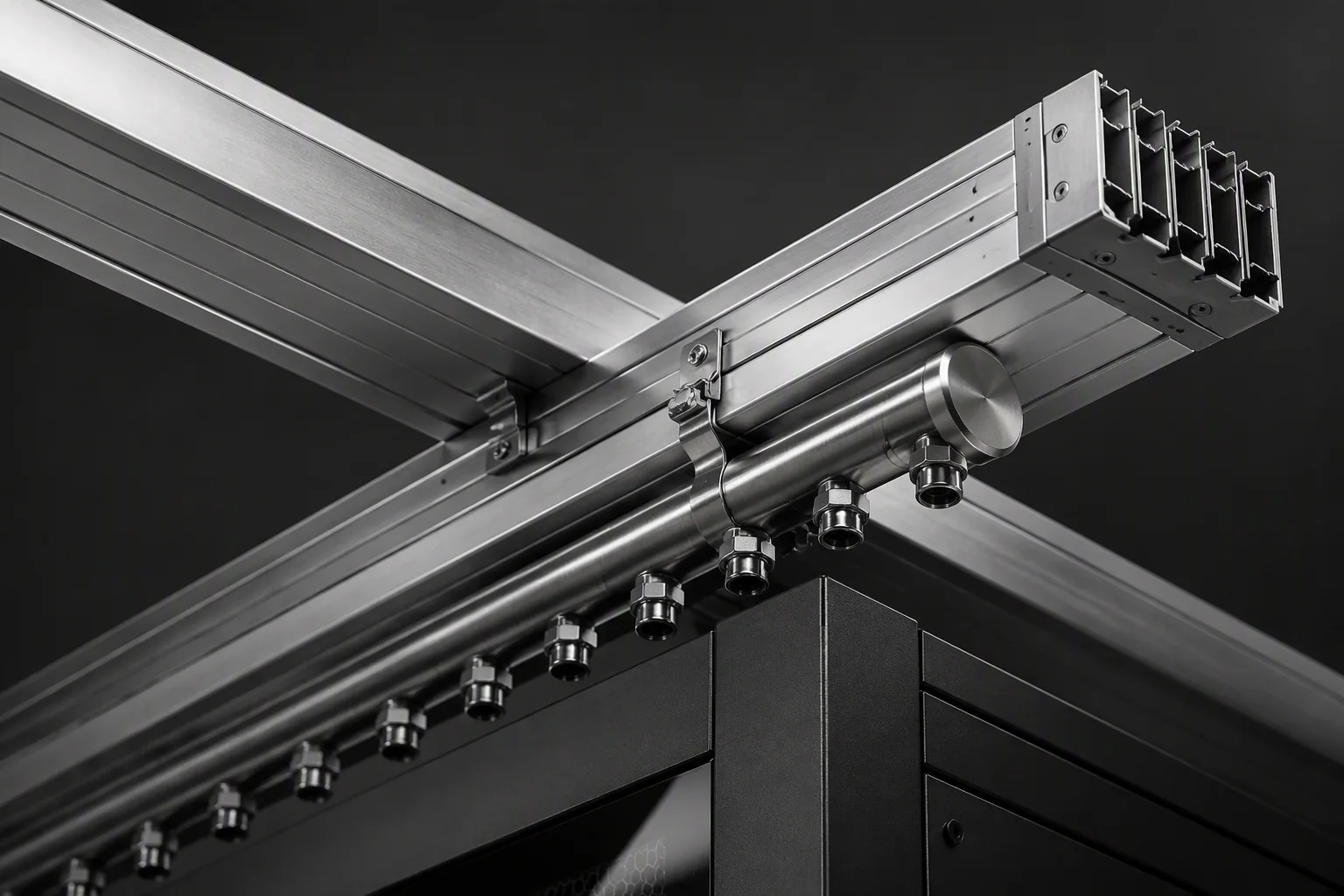
A rack row needs two utilities above it — power and coolant — and on most projects those two paths are integrated last, on site, by three trades who have never met each other's drawings. That sequence is a habit, not an engineering conclusion. When the integration moves upstream into the factory, the row stops being a construction site and becomes a delivery.
The overhead benchmark the industry set
The strongest published evidence for pre-integration is overhead: suspended infrastructure that carries power, liquid and containment above the row instead of inside it. Vertiv's SmartRun — developed with Compass Datacenters and published as an industry benchmark for this class of system — shows what the integrated approach is worth at scale: up to 400 kW per rack position on its four-bus configuration, track ratings to 8,000 A, 8-ft modules joined into runs serving 46 rack positions, a structure carrying 29,000 lb per run, liquid branches of 300 kW per position on 2-inch quick connects, and a single run supporting up to 6 MW of liquid-cooled load. The deployment figures are the point: installation 85% faster than field-built equivalents, more than 1 MW per day per crew, and a 40% saving in total cost against aisle-by-aisle infrastructure.
Few rooms buy a full suspended system. Most rooms buy racks — which is exactly why the benchmark matters. It defines the discipline a rack column should inherit: power and coolant arrive as engineered paths with published ratings, not as trades' improvisation over your aisle.
The three factory checks that make pre-integration real
"Pre-integrated" is a claim until three measurements say otherwise:
- Busbar geometry, machined not adapted. Tap-off slots are machined into both uprights — not field-cut — on columns formed to ±0.1 mm, with plug-in box brackets pre-mounted and tap-off classes in the 250–800 A band feeding toward a 400 kW per rack-position design ceiling. Alignment is checked against a gauge at assembly, so a tap-off box engages on the first try.
- A liquid loop that has already held pressure. Manifolds and UQD quick disconnects are mounted at fixed coordinates in the factory, then the assembled loop is held at 1.5× working pressure for 24 hours. The zero-drop curve ships inside the crate — the loop your pipefitters would have proven on site has already been proven once, with a record.
- Grounding you can read. Frame-to-frame continuity is measured at ≤0.1 Ω with bonding jumpers fitted before dispatch, and the reading is written on the same test record as the load and pressure results.
Any rack can be described as integration-ready. A factory that runs those three checks can print the numbers next to the description.
The cost math behind the crate
Pre-integration has to be judged against what field integration actually costs — and the inputs are unusually well documented:
- The grid sets the clock: utility uprating in major markets takes 12–24 months at over $2M per MW. Capacity planning therefore happens per row, not per hall — which rewards infrastructure that scales in row-sized increments.
- The cooling plant arrives late: each CDU adds $20,000–35,000 to the budget and, in practice, shows up after the racks. A rack whose UQD geometry was frozen at order time docks the CDU in hours; a rack whose interface is improvised on site waits for it.
- Dead weeks are billable: in high-density colocation space retailing at $170–230 per kW per month, a row that integrates two to three weeks late is measurable forgone revenue — before the trades' invoices.
- The crew math collapses: a crated, pre-integrated row needs one delivery, one install crew and one test record. Electricians work overhead on tap-off boxes instead of inside your cold aisle; pipefitters connect two UQD pairs per cabinet instead of fabricating a manifold in place.
Set against a 2–3 week field window and a 12–24 month utility clock, the factory's 30-day build time stops looking like a lead time and starts looking like the shortest path in the whole project.
What ships in the crate
Busbar-slot columns with plug-in box brackets pre-mounted — 250–800 A tap-off classes, top or under-floor feed.
≤400 kW / positionManifolds above both door lines, UQD quick disconnect pairs at fixed coordinates, 25–80 L/min on PG25.
25–80 L/min · PG25Drip pans under every union, with leak-sensor cutouts pre-wired into the rack's monitoring path.
every union pannedGrounding jumpers fitted, frame-to-frame continuity measured at ≤0.1 Ω and recorded before dispatch.
≤0.1 Ω verifiedThe pressure record — 1.5× working pressure held for 24 hours, zero-drop curve stapled to the order.
1.5× · 24 h · 0 dropBilingual drawing package — mm/inch drawings, packing list and torque log, so your crew assembles to the same numbers the factory did.
PDF + DXF per SKUWhere this lands in a project
The rack is where power and coolant cross your project's critical path, and it is the one crossing you can move upstream entirely. The full specification of each half is on the busway-integrated racks page — tap-off classes, short-circuit ratings and the 400 kW per-position ceiling — and the liquid-cooling-ready racks page, where manifold geometry, UQD coordinates and the 1.5×/24 h proof are standard delivery. Specify them as one line item, and the row's integration story ends in a crate instead of a punch list.